
Social Determinants of Health in Montana
What are Social Determinants of Health?
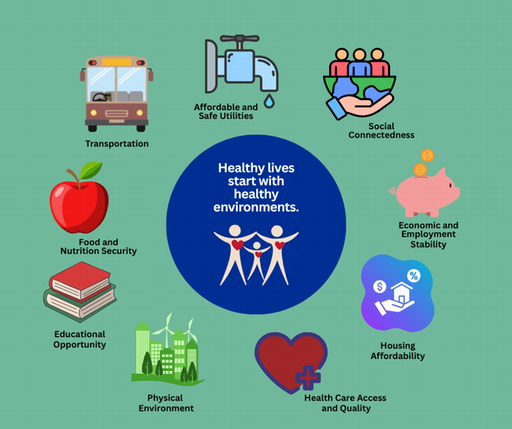
Social determinants of health are the underlying social and economic conditions that influence people's ability to be healthy.
Good health starts where we live, learn, work, and play. Stable housing, good schools, safe neighborhoods, access to jobs, and culturally responsive healthcare all play a major role in our wellbeing. Community support can take many forms, such as:
- Affordable housing programs
- Local food pantries and farmers markets
- After‑school and youth activities
- Transportation services
- Mental health resources
- Partnerships with tribal and local organizations
Montana DPHHS and the Chronic Disease Prevention and Health Promotion Bureau work with communities by sharing data, tools, and practical information about these factors that influence health. The aim is to bring together healthcare providers, community organizations, and anyone committed to improving health and well‑being. Many organizations recognize that health is shaped by far more than medical care alone. The topics we highlight don’t capture every influence, and many of them overlap. Truly understanding and supporting Montana communities means looking at several of these components together rather than in isolation. When we consider them side by side, we can take more informed action and create solutions that truly reflect the needs of Montana communities.
For more information on other Programs in the Chronic Disease Prevention Bureau, please visit their website.
“The greatness of a community is most accurately measured by the compassionate actions of its members.” – Coretta Scott King
DPHHS is one of many partners across the state supporting healthy equity initiatives. As a diverse group of healthcare professionals, nonprofit workers, and passionate community problem-solvers, we work together to benefit those that we serve, the healthcare system, and society as a whole.
We recognize that some people in Montana have more opportunities than others due to historical marginalization and discrimination in the areas of healthcare access, housing, quality education, jobs with fair pay, and safe environments. Health equity adjusts resources towards historically disadvantaged groups and addresses SDOH and health disparities. By acknowledging and addressing inequities, the Chronic Disease and Prevention Bureau hopes to serve all Montanans with dignity, respect and a deep cultural understanding.
Health equity and social determinants of health are heavily emphasized in the 2023 State Health Assessment (SHA) and the 2024 State Health Improvement Plan (SHIP). A network of partners from state, local, and tribal government, non-profit, health care, business, and other sectors are using data from the SHA and the SHIP to address their mission: To protect and improve the health of every Montanan through evidence-based action and community engagement. (https://dphhs.mt.gov/ahealthiermontana/)