

Antimicrobial Resistance and Stewardship
Microbes (germs) that cause human and animal diseases have developed the ability to resist the killing effects of antimicrobials. Everyone is at risk of being sick with a bacterial or fungal infection that is resistant to antimicrobials. These types of infections are hard to get rid of and require other treatments that are sometimes costly and toxic.
The causes of antimicrobial resistant bacteria and fungus are numerous. Sometimes, this happens when people take antimicrobials differently than how the physician prescribed, or when people take antimicrobials when they are not needed.
Antimicrobials are not needed to treat illnesses caused by viruses. The common cold is caused by a virus. Most coughs, bronchitis, runny noses, and sore throats (not caused by strep) are not caused by bacteria and cannot be cured by using antimicrobials.
Unfortunately, antimicrobials can cause harm by eliminating the ‘good’ bacteria from the body. When the good bacteria are eliminated, patients sometimes become infected with Clostridium difficile which is also difficult to treat and causes severe illness. In the United States, it is estimated that C. difficile causes almost half a million infections a year. Outbreaks of C. difficile should be reported.
In the United States, more than 2.8 million infections and 35,000 deaths are caused by antimicrobial-resistant organisms each year. This is one of the most pressing public health threats in the US. 2019 Antibiotic Resistance Threats Report | Antimicrobial Resistance | CDC
For frequently asked questions and answers about antibiotic resistance, visit About Antimicrobial Resistance | Antimicrobial Resistance | CDC
- Know your risk and ask questions.
- Clean your hands.
- Get vaccinated.
- Use antibiotics and antifungals appropriately.
- Be aware of changes in your health.
- Practice healthy habits around animals.
- Prepare food safely.
- Stay healthy when traveling abroad.
- Prevent sexually transmitted infections (STIs).
Controlling the Emergence and Spread of Antimicrobial Resistance | Antimicrobial Resistance | CDC
- Develop a communication strategy to notify health care facilities of transferred patients with antimicrobial-resistant infections and/or recent antibiotic use.
- Develop an antimicrobial stewardship program to promote appropriate use of antibiotics.
- Core Elements of Hospital Antibiotic Stewardship Programs
- Core Elements of Outpatient Antibiotic Stewardship
- Core Elements of Antibiotic Stewardship for Nursing Homes
- Core Elements of Human Antibiotic Stewardship Programs in Resource-Limited Settings
- Core Elements of Antibiotic Stewardship for Health Departments
- Strive to immunize all staff as recommended.
- Follow good infection control and prevention processes which include hand hygiene.
- Teach infected patients and visitors how to prevent spreading their infections.
Health care facilities provide their attestation to meeting these core elements yearly through the NHSN Patient Safety and Long-Term Care Component Annual Surveys. All core element data was retrieved from NHSN via the Montana DPHHS DUA with NHSN. Data only represents those facilities that report data into NHSN.
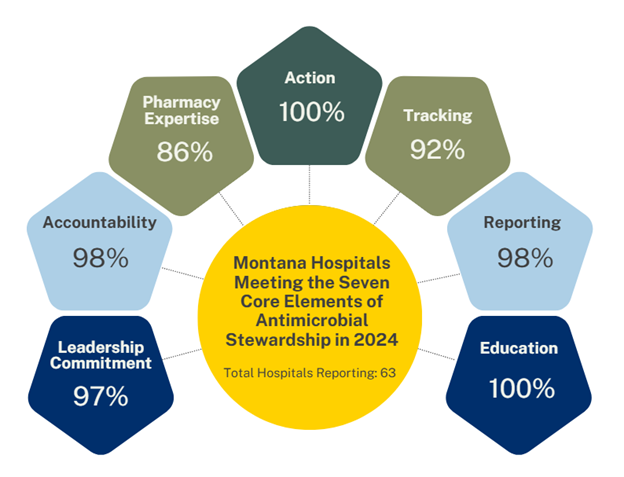
To aid Montana health care facilities in meeting the seven core elements of antimicrobial stewardship, the Montana DPHHS in conjunction with the University of Montana Skaggs School of Pharmacy, hosts a free, yearly antimicrobial stewardship program.
The antimicrobial stewardship program is designed to help acute care hospitals, associated long-term care, and outpatient care facilities meet the requirements of the proposed federal rule 42 CFR 482 and 485 and the resulting Joint Commission standards (June 2016) and Centers for Medicare and Medicaid Services (CMS) Conditions of Participation (COP) elements requiring antimicrobial stewardship programs for accreditation of hospitals, critical access hospitals, and nursing care centers. The program may help hospitals illustrate cost savings. It is the goal of this program to improve patient care and patient outcomes.
Want to view Montana data and learn more about antimicrobial prescribing practices? Visit CDC's A.R. & Patient Safety Portal located here and select "Montana": A.R. & Patient Safety Portal.